
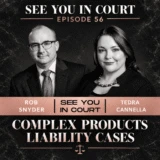
Episode 56: Complex Product Liability Cases with Tedra Cannella and Rob Snyder
Episode 56: Complex Product Liability Cases with Tedra Cannella and Rob Snyder
What happens when a product works exactly as designed, but that design puts people at risk? How can investigators uncover the truth when an accident report doesn’t tell the whole story? And what does justice look like when a family suffers a devastating loss?
In this episode of See You In Court, hosts Robin Frazer Clark and Lester Tate welcome attorneys Tedra Cannella and Rob Snyder, founding partners of Cannella Snyder LLC, for an engaging conversation about complex product liability cases, consumer safety, civil litigation, and the pursuit of justice in Georgia.
The guests take listeners behind the scenes of significant cases involving defective vehicle safety systems, dangerous workplace machinery, fatal trucking accidents, wrongful death, and whistleblower litigation.
Among the stories are a $127 million product liability verdict involving a seat belt, a $56.5 million wrongful death verdict, and a trucking investigation in which overlooked evidence helped explain how a fatal collision occurred.
Along the way, Tedra and Rob explain how Georgia’s civil justice system addresses dangerous products, why complex cases can take years to resolve, and how the legal process can help individuals and families pursue accountability.
Watch the complete episode: Episode 56 on YouTube
Prefer to listen? Listen on Podbean
Meet Tedra Cannella and Rob Snyder
Tedra Cannella and Rob Snyder are founding partners of Cannella Snyder LLC, a Georgia law firm that represents individuals and families in complex civil litigation.
Tedra’s interest in helping injured people began with her own experience as a burn survivor following a house fire while she was attending Emory University. Her subsequent work with children who had suffered serious burns inspired her commitment to public service and the law.
After college, she spent two years with AmeriCorps, working with legal aid organizations in Missouri and Georgia. She later earned a graduate degree in public policy from Georgetown University and attended law school at the University of Georgia.
Her legal practice focuses on product liability, wrongful death, breach of fiduciary duty, and serious automobile and trucking accidents. She is also active in consumer advocacy through Georgia Watch and the Georgia Trial Lawyers Association.
Rob Snyder began his career clerking for United States District Court Judge Harold Murphy before working in business litigation defense. He transitioned to representing plaintiffs in 2015 and founded Cannella Snyder with Tedra in 2021.
His practice includes wrongful death, personal injury, and whistleblower litigation. He also serves in leadership roles with the Georgia Trial Lawyers Association and has written and presented on legal topics including the False Claims Act, arbitration, and evidence.
Together, they bring experience with complicated cases that often involve major corporations, extensive technical evidence, and difficult questions about responsibility.
What Is Product Liability and Why Does It Matter?
Product liability concerns the legal responsibility that manufacturers and certain other parties may have when defective or unreasonably dangerous products cause injuries.
Tedra explains that manufacturers have a duty to make products reasonably safe. That responsibility can involve the product’s design, the manufacturing process, and appropriate warnings about potential dangers.
The conversation explores three major categories of product defects:
- Design defects: The product is manufactured as intended, but its design may create an unreasonable safety risk.
- Manufacturing defects: Something goes wrong during production, causing a particular product to differ from its intended design.
- Failure to warn: A product may lack adequate warnings or instructions about foreseeable dangers.
According to Tedra, design defects are especially common in the cases her firm handles. These may involve automobile safety equipment, industrial machinery, or other products whose design contributes to an injury.
The guests also discuss a case involving an industrial printing press that lacked an appropriate pressure-release mechanism. The example illustrates how even a relatively simple design decision can have significant consequences.
Georgia’s 10-Year Statute of Repose: Why Product Age Matters
One of the episode’s most useful discussions concerns Georgia’s statute of repose for product liability cases.
Tedra explains that Georgia generally has a 10-year statute of repose for certain product liability claims, measured from the product’s first sale for use or consumption.
This differs from a statute of limitations, which generally addresses how long someone has to file a claim after an injury or another legally significant event.
Rob points out that the statute of repose can become especially important when an injury involves an older automobile or industrial machine. A person may suffer an injury recently, only to discover that the product involved was originally sold more than 10 years earlier.
The attorneys discuss exceptions and other potential legal theories, including claims involving a manufacturer’s continuing duty to warn.
Robin raises a practical question that many consumers may not have considered: What happens when someone purchases a used car?
As the guests explain, buying a used vehicle does not restart the original 10-year period. The date of its first sale remains important.
The conversation also touches on advances in automotive safety technology and why drivers should pay attention to warning indicators, particularly those involving airbag systems.
Workplace Injuries and Defective Machinery
When someone is injured on the job, workers’ compensation is often the first source of benefits. But what happens when defective equipment contributed to the accident?
Tedra and Rob explain that some workplace injuries may involve separate product liability claims against manufacturers or other responsible third parties.
These cases can require extensive investigation to identify who designed, manufactured, modified, or maintained the equipment.
Rob describes situations involving machinery that had been altered or assembled over many years, making it difficult to determine which company or individual was responsible for a particular component.
The distinction matters because workers’ compensation and third-party civil claims provide different types of remedies and operate under different legal rules.
The discussion demonstrates why understanding the equipment and circumstances surrounding an accident can be essential to evaluating a potential case.
Andrews v. Autoliv: A $127 Million Product Liability Verdict
One of the episode’s central stories involves Andrews v. Autoliv, a federal product liability case that resulted in a $127 million bench verdict.
Tedra explains that Mike Andrews was driving home from work at the Georgia Aquarium when he swerved to avoid a turtle, left the roadway, and struck a group of trees.
During the collision, his airbag did not deploy, and his seat belt extended approximately 20 inches.
According to Tedra, the investigation raised serious questions about the seat belt’s design and its relationship to the vehicle’s airbag system.
The attorneys examined how vehicle safety systems are evaluated during crash testing and how design choices intended to improve one safety measurement can affect performance in other collision scenarios.
The case originally involved claims against both the vehicle manufacturer and the seat belt manufacturer. After resolving the claim against Mazda, the litigation continued against the seat belt manufacturer.
What followed was a lengthy legal battle.
An initial summary judgment ruling went against the plaintiffs, but the Eleventh Circuit Court of Appeals reversed that decision. Subsequent evidence raised additional questions about the seat belt manufacturer’s role in the design.
Ultimately, the case proceeded as a bench trial, meaning a judge rather than a jury decided the outcome.
The resulting $127 million verdict illustrates the complexity of product liability litigation and the importance of engineering evidence, discovery, appellate review, and judicial decision-making.
Why Choose a Bench Trial Instead of a Jury?
The Andrews case leads to a discussion about an interesting litigation strategy: choosing to have a judge decide a case rather than presenting it to a jury.
In a bench trial, the judge evaluates the evidence and determines the outcome. In a jury trial, that responsibility generally belongs to jurors selected from the community.
Tedra and Rob explain why they sometimes favor bench trials in complex litigation, particularly when the issues involve highly technical evidence.
They discuss potential efficiencies in presenting evidence, addressing legal questions, and avoiding disputes over jury instructions.
The conversation also challenges a common assumption about large civil verdicts. The $127 million Andrews verdict was reached by a federal judge, not a jury.
For listeners, the discussion offers an accessible look at how civil trials work and why the choice of fact-finder can affect the litigation process.
The Buchanan Case: A $56.5 Million Wrongful Death Verdict
Rob Snyder shares another deeply personal case involving Beth Buchanan, a 26-year-old University of Georgia doctoral student whose life was cut short in a devastating automobile collision.
Beth was driving her mother toward Atlanta when a wrong-way driver struck their vehicle near Athens. Beth was killed, and her mother suffered serious injuries.
According to Rob, the driver responsible for the collision subsequently fled and remained a fugitive at the time of the episode recording.
While the family addressed available insurance coverage, they also wanted a judicial proceeding that would formally recognize what happened to their daughter.
Rob explains that the family sought more than a financial recovery. They wanted an opportunity for Beth’s life and the circumstances of her death to be acknowledged by the court.
During a damages hearing in Clarke County, family members, friends, and others who knew Beth testified about her accomplishments, relationships, and the remarkable person she had been.
The court ultimately awarded a $56.5 million judgment.
Rob acknowledges that collecting the full amount of a judgment can be difficult when a defendant lacks sufficient assets.
Yet the case illustrates an important distinction between obtaining a financial recovery and achieving a measure of justice through formal recognition and accountability.
The Martinez Trucking Case: When the Evidence Tells a Different Story
Another compelling story involves a fatal tractor-trailer accident on Interstate 75.
The initial accident investigation concluded that a passenger vehicle had struck a tractor-trailer and caused the truck to lose control.
But witness statements suggested a different account. Several people described the tractor-trailer suddenly moving across multiple lanes of traffic, creating a situation in which other drivers had little opportunity to avoid a collision.
Rob explains how further investigation involved accident reconstruction, dashcam footage, vehicle evidence, and detailed analysis of the truck’s braking system.
The evidence led investigators to consider whether the truck’s emergency brake had been accidentally activated while traveling at highway speed.
A decorative accessory attached to the brake control became an important part of that explanation.
By examining video, audio recordings, skid marks, and other physical evidence, the legal team developed an account that challenged the original findings.
The case ultimately settled, but it offers a powerful illustration of why accident reconstruction and expert testimony can play such important roles in civil litigation.
It also reinforces another point Tedra and Rob emphasize: Although lawyers may want to take a case to trial, the ultimate decision about settlement belongs to the client.
Aftermarket Automotive Products and Consumer Safety
The guests also explore product liability cases involving aftermarket automotive equipment, including products added to vehicles after their original manufacture.
Tedra explains that these cases can present different challenges from litigation involving major automobile manufacturers.
Smaller manufacturers may have different engineering, testing, and documentation practices, and identifying how a product was designed and evaluated can become central to the case.
Although confidentiality agreements limit what Tedra can reveal about one particular matter, the discussion emphasizes the importance of product testing and responsible design decisions.
It is a reminder that consumer safety issues may involve not only the original vehicle manufacturer but also companies producing accessories and replacement components.
False Claims Act Litigation and Whistleblower Protection
The conversation moves beyond traditional product liability cases when Rob discusses his work involving the federal False Claims Act.
Sometimes called the Lincoln Law because of its Civil War origins, the False Claims Act provides a way to address certain forms of fraud involving federal government funds.
Under its whistleblower provisions, qualifying individuals can bring lawsuits on behalf of the government. Those individuals, known as relators, may receive a portion of a recovery under applicable circumstances.
Rob describes a complex case involving a healthcare software company, alleged security issues, and extensive litigation over evidence and expert testimony.
The case lasted approximately eight years from the initial client meeting to settlement and involved millions of pages of documents, numerous depositions, and significant disputes over discovery.
Rob explains how the court issued sanctions related to the handling of evidence and representations made during the proceedings.
The case ultimately settled during trial in 2026.
The discussion illustrates the role whistleblower lawsuits can play in addressing alleged fraud against the government and why access to evidence is so important in civil litigation.
Courtroom Ethics and an Extraordinary Hotel Controversy
One of the episode’s most unexpected stories involves what Robin jokingly describes as a hotel controversy during preparations for a federal trial in Macon.
Rob recounts how his team’s hotel reservations were unexpectedly canceled shortly before trial because of an arrangement involving the opposing legal team.
The situation became the subject of judicial inquiry and criticism.
Although the story provides some humorous moments, it also introduces a serious conversation about the professional responsibilities of attorneys.
Lawyers are expected to advocate vigorously for their clients while complying with court rules, discovery obligations, and standards of professional conduct.
Tedra and Rob discuss how questionable litigation tactics can undermine confidence in the process and why judicial oversight is essential to maintaining fairness.
The broader lesson reaches beyond any single case: A functioning civil justice system depends on participants following the rules and courts being willing to enforce them.
What Does Justice Mean to Tedra Cannella and Rob Snyder?
As with every See You In Court guest conversation, Robin and Lester conclude by asking a fundamental question: How do you define justice?
Tedra emphasizes that following the required legal procedures does not automatically mean the outcome will feel just.
For her, justice involves reaching a result that appropriately reflects the facts, the law, and the harm experienced by the people involved.
Rob focuses on fairness and equality, particularly the opportunity for every person to present a case and receive meaningful consideration regardless of the resources or influence of the opposing party.
He recalls a case involving an injured Georgia soldier that reached the United States Supreme Court and describes how hearing his client’s name discussed before the nation’s highest court reinforced his appreciation for the legal system.
Although their answers differ in emphasis, they share a central belief that access to a fair and independent judicial process is essential to the pursuit of justice.
Legal News: Judicial Conduct and Constitutional Rights
Following the guest interview, Robin and Lester discuss two legal news stories involving courtroom authority and individual rights.
Lester examines developments in a Kentucky criminal case involving a former sheriff charged with killing a judge, including a dispute over an additional mental health examination and the defendant’s constitutional protections.
Robin discusses an Alabama case involving the arrest of a prospective juror for arriving late to court and questions about how that incident affected the remaining jurors.
Both discussions raise broader issues about judicial discretion, fairness, due process, and public confidence in the courts.
Episode Chapters
- 00:00 – Introduction
Welcome to See You In Court and an overview of the podcast’s mission. - 00:56 – Welcome to Episode 56
Robin Frazer Clark and Lester Tate introduce the conversation. - 01:45 – Meet Tedra Cannella and Rob Snyder
The guests’ backgrounds, legal careers, and areas of practice. - 05:40 – Understanding Product Liability
Design defects, manufacturing defects, and warnings. - 07:10 – Defective Products and Workplace Injuries
Examples involving vehicles, machinery, and other products. - 09:21 – Georgia’s 10-Year Statute of Repose
How product age and legal deadlines affect potential claims. - 11:39 – Types of Product Defects
Why design defects are a major focus of the guests’ practice. - 12:15 – Vehicle Safety and Older Cars
Airbags, safety technology, and used vehicles. - 15:16 – Workplace Injuries and Workers’ Compensation
When defective machinery may involve additional legal claims. - 17:38 – Andrews v. Autoliv
The $127 million defective seat belt verdict. - 22:53 – Bench Trials vs. Jury Trials
Why the attorneys sometimes prefer trials decided by judges. - 28:36 – The Buchanan Wrongful Death Case
A $56.5 million verdict and a family’s pursuit of recognition. - 36:34 – Investigating a Fatal Trucking Accident
How the initial findings came under scrutiny. - 39:11 – Uncovering Critical Evidence
Accident reconstruction, video analysis, and an emergency brake. - 46:43 – Settlement Decisions
Why clients sometimes choose resolution over trial. - 48:18 – Aftermarket Automotive Products
Safety concerns involving vehicle accessories and components. - 52:37 – Challenging Major Manufacturers
Engineering evidence and complex product liability defenses. - 54:14 – The False Claims Act
Whistleblower litigation and alleged fraud against the government. - 57:42 – Evidence Disputes and Courtroom Sanctions
Discovery obligations, expert testimony, and judicial oversight. - 01:04:37 – The Hotel Controversy
An unusual pretrial dispute in Macon, Georgia. - 01:12:58 – Defining Justice
Tedra and Rob share their perspectives on fairness and outcomes. - 01:17:43 – Legal News
Judicial conduct, constitutional rights, and courtroom authority. - 01:26:20 – Closing Remarks
Final thoughts and how to follow See You In Court.
Notable Moments
- Why a product can be manufactured correctly but still have a dangerous design
- How Georgia’s statute of repose can affect claims involving older vehicles
- The seat belt design questions at the center of a $127 million federal verdict
- Why the Andrews case was decided by a judge rather than a jury
- How a $56.5 million wrongful death judgment helped recognize the value of a young woman’s life
- The overlooked evidence that changed the understanding of a fatal trucking crash
- Why a client’s decision to settle may differ from an attorney’s desire to proceed to trial
- How whistleblower litigation can reveal alleged fraud involving government funds
- An extraordinary hotel dispute and its implications for courtroom professionalism
- Two perspectives on justice: fair procedures and meaningful outcomes
Related Links and Resources
- Cannella Snyder LLC
- Watch Episode 56 on YouTube
- Listen to Episode 56 on Podbean
- Robin Frazer Clark
- Lester Tate
- Georgia Civil Justice Foundation
Frequently Asked Questions
What is product liability in Georgia?
Product liability involves legal claims arising from injuries caused by defective or unreasonably dangerous products. These cases may involve unsafe designs, manufacturing defects, or inadequate warnings. Georgia law establishes requirements and deadlines that can affect whether a claim may proceed.
What are the three main types of product defects?
The three commonly discussed categories are design defects, manufacturing defects, and failure to warn. A design defect concerns the product’s intended design. A manufacturing defect involves a problem introduced during production. A failure-to-warn claim concerns inadequate safety instructions or warnings about potential dangers.
What is Georgia’s statute of repose for product liability claims?
Georgia generally has a 10-year statute of repose applicable to certain product liability claims, measured from the product’s first sale for use or consumption. Important exceptions and qualifications exist. The rule is different from a statute of limitations and can affect claims involving older products even when an injury occurred recently.
Does buying a used car restart the product liability statute of repose?
No. As discussed in the episode, the relevant period generally begins with the vehicle’s original sale for use or consumption, not a later resale. Purchasing a used vehicle does not ordinarily restart that period.
Can someone injured at work file a product liability lawsuit?
Potentially. When defective machinery or equipment contributes to a workplace injury, a separate claim against a responsible third party may be possible. Such claims are distinct from workers’ compensation and depend on the circumstances, including who designed, manufactured, modified, or maintained the equipment.
What happened in Andrews v. Autoliv?
Andrews v. Autoliv involved questions about seat belt design and performance during a vehicle collision. Following extensive litigation and an appeal, the case resulted in a $127 million federal bench verdict. Tedra Cannella discusses the investigation, disputed design decisions, and the role of the seat belt manufacturer.
What is the difference between a bench trial and a jury trial?
In a bench trial, a judge serves as the fact-finder and decides the outcome. In a jury trial, jurors evaluate the evidence and reach a verdict. Tedra and Rob discuss why a bench trial may sometimes be appropriate in complex civil litigation involving technical evidence.
Why did the Buchanan family pursue a wrongful death judgment?
According to Rob Snyder, the family wanted formal judicial recognition of Beth Buchanan’s death and the value of her life. The case resulted in a $56.5 million judgment. The discussion illustrates why the significance of a civil judgment may extend beyond the amount that can ultimately be collected.
How can accident reconstruction change the outcome of a trucking case?
Accident reconstruction uses physical evidence, vehicle information, video recordings, witness testimony, and technical analysis to better understand how a collision occurred. In the Martinez case discussed in Episode 56, additional investigation challenged the initial findings and supported a different explanation of the crash.
What is the False Claims Act?
The federal False Claims Act addresses certain forms of fraud against the federal government. Its whistleblower provisions allow qualifying individuals to bring lawsuits on the government’s behalf. Under certain circumstances, a successful relator may receive a share of the recovery.
Why are courtroom ethics important in civil litigation?
Civil litigation depends on rules governing evidence, disclosure, and professional conduct. When attorneys or other participants fail to follow those rules, courts may impose sanctions or other remedies. The guests discuss why fair procedures and the responsible handling of evidence are essential to public confidence in the justice system.
How do Tedra Cannella and Rob Snyder define justice?
Tedra emphasizes the importance of reaching an outcome that appropriately reflects the facts, the law, and the circumstances of a case. Rob focuses on fairness and equality, particularly the opportunity for individuals to present their cases regardless of the resources or influence of the opposing party.
Stay Connected
Follow See You In Court on Facebook:
facebook.com/SeeYouInCourtPodcast
Subscribe to our YouTube channel:
Subscribe to See You In Court
Explore additional episodes and resources:
SeeYouInCourtPodcast.org
About See You In Court
See You In Court is a Georgia civil justice podcast brought to you by the Georgia Civil Justice Foundation and hosted by Robin Frazer Clark and Lester Tate, both past presidents of the State Bar of Georgia.
Through conversations with judges, attorneys, legal scholars, public officials, and others involved in the justice system, the podcast helps Georgians better understand individual rights, the courts, the rule of law, and the importance of an independent judiciary.
The podcast is free and available anytime because understanding how our justice system works helps all Georgians participate more effectively in it.
Please note: The information provided on this website and within our blog posts is intended solely for educational and informational purposes as a public service by the Georgia Civil Justice Foundation.
Legal issues can be complex and individualized. If you are seeking legal advice, please contact a licensed attorney in your jurisdiction who can provide legal guidance that suits your particular situation.
Stay Connected
👍 Follow us on Facebook: See You In Court Podcast
▶️ Subscribe on YouTube: See You In Court Channel
About See You In Court
See You In Court is Georgia’s leading civil justice podcast, brought to you by the Georgia Civil Justice Foundation. Our mission is to educate, inform, and empower citizens about their rights and the importance of an independent civil justice system.
The podcast is free and available anytime—because understanding justice is a right every Georgian deserves.
⚖️ Please note: The information provided on this website and within our episodes is for educational purposes only. For legal advice on your specific situation, please contact a licensed attorney in your jurisdiction.
See You in Court Podcast Episode: Georgia’s Nick Moraitakis on Landmark Civil Justice Cases, Mediation, and the Rule of Law
Episode: Georgia’s Nick Moraitakis…
See You in Court Podcast
Episode: Georgia’s Nick Moraitakis on Landmark Civil Justice Cases, Mediation, and the Rule of Law
Hosts: Robin Frazer Clark & Lester Tate
Guest: Nick Moraitakis
Sponsor: Georgia Civil Justice Foundation
## Intro & Welcome
[Music Intro] Voiceover: Hello and welcome to See You in Court, a podcast that informs you about the Georgia civil justice system, what it means to you, and how it protects individual rights. During each episode, we dive deep into stories, cases, and insights that matter to Georgians. You can learn more on our website at www.seeyouincourtpodcast.org. Join the conversation on our YouTube channel at See You in Court Podcast and stay connected with us on our Facebook page. This podcast is sponsored by the Georgia Civil Justice Foundation. Your hosts are Robin Frazer Clark and Lester Tate, who are both past presidents of the State Bar of Georgia and who both serve on the board of directors of the Georgia Civil Justice Foundation. And now, this episode of See You in Court.
Robin Frazer Clark: Good morning friends and lovers of the law and welcome to See You in Court. I’m Robin Frazer Clark and with us here today is our co-host, Lester Tate. Hey, Lester.
Lester Tate: Hey, Robin! First show of the new year here. We’re taping on Friday the 13th. Are you superstitious at all?
Robin: I am not. My mom was from West Virginia and that is a superstitious bunch, but Bill and I were married on the 13th, so it’s a lucky number for me. Starting out the new year, we have a great lineup, and the first is Nick Moraitakis, who is with us today. Nick, glad to have you.
Nick Moraitakis: Absolutely. Thank you. Yes, I appreciate the opportunity to spend this time with you.
## Guest Introduction: Nick Moraitakis
Robin: Let me introduce our listeners to Nick.
Roots: Nick is a native Atlantan, attended public schools in DeKalb County, and worked his way through Emory College and Emory Law School. He is the first in his extended family to graduate college.
Early Career: He earned internships in the Department of Natural Resources during Jimmy Carter’s governorship and in the U.S. Congress in 1975.
Defense Work: After graduating in 1977, he spent 14 years representing insurance companies and self-insured corporations, trying dozens of cases to verdict (auto, truck, product liability, negligent security).
Plaintiff Practice: In 1993, Nick and his law partner Glenn Kushel began a plaintiff’s practice dedicated exclusively to individuals injured or killed by medical malpractice, nursing home abuse, trucking accidents, and product liability.
Mediation: He began a very successful mediation practice with Henning Mediation 16 years ago and has turned to 100% mediation in the last two years.
Accolades: Fellow of the American College of Trial Lawyers, Advocate with the American Board of Trial Advocates, and winner of the Tradition of Excellence Award.
Lester: When you read that, Robin, I want to be Nick Moraitakis when I grow up! [Laughter]
## Political Origins & Early Influences
Robin: Nick, you’ve been practicing almost 50 years now. Tell us a little bit about what motivated you to become a lawyer in the first place.
Nick: Well, that’s very kind. I’ll tell you one thing—the ‘D’ I got in biology my freshman year at Emory eliminated the possibility of becoming a doctor! But I grew up interested in politics and government. John F. Kennedy’s vigor and youth inspired me.
When I graduated high school in 1970, it was a wild political year in Georgia. Jimmy Carter was running for governor against a slew of folks, including Carl Sanders (whom Jimmy labeled “Cufflinks Carl”), an avowed racist named J.B. Stoner, and a very sharp African-American lawyer/minister candidate from Albany by the name of C.B. King.
I got retained as a personal aide to Charlie Jones, who was running for Lieutenant Governor against Lester Maddox. Back then, politicking was town halls and forums all over the state. I got to see remarkable debates.
Later, I interned during the ’73 and ’74 legislative sessions for the Department of Natural Resources under Jimmy Carter. We had giants in the legislature then: Elliot Levitus, Sydney Marcus, Julian Bond, Max Cleland. We put together meaningful bills like the Chattahoochee River Bill and the Sand Dunes Bill. That got me into studying legislation. Law was just a natural fit for me.
Lester: It’s been said before that if war is diplomacy by other means, trials and court are politics by other means. True or false?
Nick: Yeah, except more civil! Because you have real rules. Politics today, as we all know, is completely freewheeling.
## Running for Office and the Georgia Legislature
Robin: When did you get the bug to run for office?
Nick: In 1984, Elliot Levitus got beat by Pat Swindle. Pat went to my high school, and when he beat Elliot and was so cocky about it, I thought about running. Later, I ran in the Democratic primary against Ben Jones.
Lester: Ben Jones from the Dukes of Hazzard?
Nick: Yes, he was “Cooter.” I didn’t appreciate how much name recognition meant. He beat me. That’s my claim to fame: getting beaten in an election by Cooter from the Dukes of Hazzard. I wear that label proudly.
Lester: “You haven’t lived the highs and lows of life until you’ve lost an election and won a jury trial.”
Robin: But later in your career, you did run for the Georgia House and got elected. It seems so hard to maintain a law practice and serve in the legislature.
Nick: It was a very hard time. Roy Barnes had redrawn the maps, creating a multi-member district that ran from Sandy Springs down to the Georgia Dome. We only had about 30 lawyers in the legislature at the time. If you’re a lawyer who does good work, you get pulled in every direction. Next thing you know, you’re helping people write their bills and explaining them. It was very busy and very contentious because we were fighting tort reform, the flag debate, and teacher salaries.
## The Art of Mediation
Robin: Let’s talk about your mediation practice. You are a highly sought-after mediator. Both defense and plaintiff attorneys readily agree to use you. What did your experience on both sides bring to your mediation practice?
Nick: I got involved after a health scare when I was 58, thinking I wanted to slow the litigation practice down. The slowing down didn’t work out as I’d hoped, but I love doing it now because it keeps my mind busy.
I appreciate what defense lawyers do; they are busy as they can be, and I was there once. Furthermore, our firm did a lot of medical malpractice stuff, so I tend to get a high percentage of medical malpractice mediations now, which are tough and complicated. It also helps that I understand the stress of the plaintiff in the room—the “rookie” in the room. The defense side often doesn’t appreciate that pressure.
Lester: I went up to Harvard Law School recently and did their mediator training. I still worry about how hard it is to take off that advocacy hat and put on the neutral hat. What’s the most difficult part?
Nick: Patience. That is the hard part. Some of my best friends are defense lawyers and they say, “I don’t know how you have the patience for that.” That is the main characteristic you must have.
Also, the mediation landscape has changed. In the old days, you didn’t go to mediation until you tried to settle amongst yourselves and couldn’t. Now, a plaintiff sends a demand, the defendant says they’ll mediate, and that’s the first time they talk. Lawyers very seldom have serious settlement conversations before getting into the room. Because of that, I’m seeing more cases that don’t settle on the day of mediation, though I stay on them and get them done months later.
## Landmark Case 1: The Shooting of Kathryn Johnston (2006)
Robin: I want to talk about a couple of your famous cases. The first is the fatal 2006 shooting of Kathryn Johnston, a 92-year-old woman, by Atlanta Police Department narcotics investigators (the “Red Dog” unit). They burst into her home unannounced on a no-knock warrant, she tried to protect herself with a gun, and they shot and killed her. Then they planted drugs to cover it up. You represented her family.
Nick: Yes, Kathryn Johnston had no husband or children. Her sister was represented by the Cochran Firm (Hezekiah Sizemore and Jon Williams), and I was hired by the family of her deceased brother. We decided to handle it together, which was smart.
To keep the city in play—where the money was—we had to overcome municipal immunity by proving what these officers did was part of an unwritten policy of the police department under the Monell doctrine. That is incredibly hard to prove.
Here is what happened in a nutshell:
The Quota System: There was an unwritten quota for these drug units to have a certain number of arrests per month. It was the week of Thanksgiving, the end of the month was nearing, and this team needed one more drug arrest.
The Informant: They pressured a confidential informant (CI) on parole to give them an address of a heavy-duty drug house. He gave them an address, but it was a street away from Miss Johnston’s home.
The Falsified Warrant: To get a no-knock warrant, they lied in the affidavit, claiming they had already sent someone in to buy drugs at her house. They hadn’t.
The Raid & Cover-Up: They busted into the wrong house. She fired a warning shot into the air, and they unloaded on her. When they realized their mistake, they literally went into her basement, planted drugs, and lied about everything.
Robin: Who found the cover-up?
Nick: The FBI got involved and went to see the confidential informant. The CI said, “No, I’m not playing this game,” and he came clean.
From there, two of the officers reached out to us through their lawyers because they were facing serious federal prison time. We spent entire days with them, and they gave us the roadmap to prove the quota system existed. They identified emails and told us who would confess under oath. We deposed everyone—every colonel, sergeant, lieutenant, the Chief of Police, and city council members.
We aggressively filed a motion for summary judgment. The city moved to remove the case, but federal Judge Marvin Shoob had the case. He called us for a pre-trial hearing and said over the phone: “I want you guys to mediate this case before I rule on this motion, because somebody is not going to like the outcome.” [Laughter] Neither side knew which one of us he was talking about! We mediated and settled for $4.9 million.
## Landmark Case 2: The 1993 Midtown Marriott Sinkhole Disaster
Robin: The second famous case is the 1993 sinkhole disaster at the Marriott Courtyard Hotel in Midtown Atlanta. A massive sinkhole opened in the parking lot, two people died, and it presented an unbelievably complicated array of geological, engineering, and geotechnical issues.
Nick: Yes, technically a sewer collapse. A Guatemalan man, Oscar Cano, and a Russian woman died. The Russian lady’s car fell through and she got stuck; my client, Oscar Cano, got sucked through the sewer and washed out into Tanyard Creek. It was a horrible death.
We took so many depositions we had to set aside one week every month. When we first got involved, the defendants had already locked up all the local geotechnical engineers from Georgia Tech. We had to find an expert from Purdue University, Dr. Milton Harr, to teach us the science.
What the documents ultimately showed was unbelievable corporate greed intersecting with municipal incompetence:
The History: The sewer, known as the Orme Street trunk, was built in the early 1900s as a massive concrete cylinder you could drive a car through. Over the years, with the construction of I-85, the city just dumped dirt on top of it. The trunk was never designed to handle that weight or the massive water runoff from heavy rains.
Marriott’s Knowledge: Marriott wanted into Midtown. Ted Turner had previously looked at the property to expand CNN but backed out after his engineers went into the trunk, took photos of cracked floors, and warned that nothing heavy should ever be built near it. Marriott found these reports, discussed the sewer in their board meetings, and decided to build a high-rise on the solid granite portion of the site while placing the parking lot directly over the dangerous sewer.
The Falsified “Safety Net”: To protect the parking lot, Marriott commissioned a company called Tensar to build a subterranean structural grid or “safety net.” It was supposed to hold the soil for four days if a crack occurred, allowing time to warn people. They never told the hotel staff about this system.
The Failure: On the Thursday before the collapse, the head of Atlanta Public Works went into the sewer, saw massive cracks, and tried to call a repair company out of Tennessee. The company couldn’t get there until Monday. Public Works said, “We may not have until Monday,” in front of witnesses—yet they did nothing but put up a few meaningless yellow signs. On Monday morning at 6:00 a.m., it collapsed.
Robin: I remember reading that the engineering calculations for that safety net were completely botched.
Nick: Yes! I went down to Miami to spend three days with our expert, Dr. Harr, to review Tensar’s 12 pages of mathematical graph paper calculations. My trigonometry was non-existent, but Dr. Harr showed me that by page nine, the engineer had made blatant mathematical errors. It wasn’t just a negligent design; it was a negligent manufacture.
I took the defense engineer’s deposition for two days. On the second day, I walked him through his formulas line-by-line: cosine, sine, etc. We got to page nine, he stalled, and he said, “Hmm, this can’t be right. There is a series of mistakes in here.” He literally lost it. His lawyer had to call an hour-long break. He came back and admitted he completely screwed up the math. That was the end of that.
## Defining Justice and the Rule of Law
Robin: What are your thoughts about where we stand with the rule of law right now, and what can lawyers do?
Nick: I think we’re in a very dangerous, difficult, and dark place, frankly. I’m worried the law is in danger of being ignored, abused, and circumvented. I read a quote from Jon Meacham citing Alexander Hamilton, who said that with this constitutional experiment, we’re going to see how reason holds up against force. Reason requires a sense of fairness; force can be anything.
What can lawyers do? We have to speak up. With upcoming elections, we ought to volunteer to protect the polling systems. I worry about the upper courts, the delays, and the blatant ignoring of court orders without consequences. We have to keep pounding the pavement for the rule of law.
Robin: Our last question to every guest: How do you define justice?
Nick: Justice Carla Wong McMillian recently spoke to new bar admittees and talked about how no one is above the law and no one is too low to avail themselves of the law’s protections.
Nick: “I think justice relies first on an understanding that all people are equal. Equality and fairness together are what justice is all about.”
For those of us who spend our lives in the courtroom, we are fortunate. The premier place where equality and fairness come to life is when you take a person who is suffering, less fortunate, or in despair, and place them before a jury alongside a massive corporate citizen. In that room, they stand as exact equals. For trial lawyers, we don’t just talk about the concept of justice—we get to see it happen in front of our very eyes.
## Legal News Roundtable
Robin: Thank you, Nick! Now is the time in our program where Lester and I bring you a legal news item. Lester, you’re up first.
Lester’s Segment: The County Seat Lawyer
Lester: I want to share a piece from the ABA Journal from June of 1950 written by Robert H. Jackson (Supreme Court Justice and Nuremberg prosecutor) titled The County Seat Lawyer. It’s a tribute to country lawyers:
“He decided not to specialize nor did he pick and choose clients. He rarely declined service to worthy ones because of an inability to pay… He identified himself with the client’s cause fully, sometimes too fully. He would fight the adverse party, fight counsel, fight every hostile witness, fight the court, fight public sentiment, fight any obstacle. He never quit… If he lost, he joined the client at the tavern in damning the judge, which is the last right in closing any unsuccessful case… The law to him was like a religion and its practice was more than a means of support. It was a mission… A free, self-governing republic stands as a monument for the little-known and unremembered as well as the famous men of our profession.”
Robin: Beautiful. It reminds me of Attorney Bob Benham walking down the street to the courthouse in Cartersville, Georgia, and people walking behind him saying, “Attorney Benham’s going to court.” —
Robin’s Segment: Judges Running Amok in Texas
Robin: My story is about a judge in Bexar County, Texas—Judge Smedley Gonzalez. In a 2024 incident, Judge Gonzalez ordered a defense attorney, Elizabeth Russell, to be placed in handcuffs and seated in the jury box during a probation revocation hearing.
The attorney had simply asked for a moment to confer with her client, who functioned below average intellectually. The judge went off the handle, said “You’re not going to be allowed to be argumentative,” and ordered her into custody.
Fast forward to now: a Bexar County grand jury has officially indicted the judge on felony charges of unlawful restraint of a public servant and official oppression. She has been suspended from the bench.
Lester: It’s one thing to feel disrespected, but it’s hard for me to see how any rational person would feel disrespected by an attorney asking to speak to their client. When they meet in the tavern about that case, cursing the judge will be completely justified!
## Outro
Robin: Well, it’s been a great program. We want to thank our sponsor, the Georgia Civil Justice Foundation, and our producer, Philip Hoover. You can learn more about Lester Tate at akentate.com and more about me at gatrialawyers.net. See you next time!
Lester: All right, till next time. See you in court.
Voiceover: You’ve been listening to the See You in Court podcast, brought to you by the Georgia Civil Justice Foundation. For further insights and resources, visit our website at www.seeyouincourtpodcast.org. Special thanks to our producer, Philip Hoover. I’m Fred Smith, Executive Director of the Georgia Civil Justice Foundation. Until next time, we’ll see you in court.
[Music Outro]
#seeyouincourt #seeyouincourtpodcast #robinfrazerclark #lestertate #georgiaciviljusticefoundation #civiljustice
Our Latest Posts
Recent Posts

Recent Posts

October 9, 2026Deepfakes, AI, and the Right to Your Own Voice in Georgia

October 9, 2026How Georgia Statutory Law Protects Everyday Workers


